

Today, natural hair extensions are THE solution for achieving the hair of your dreams. Latou Hair Concept offers hair extension application to meet your desire for hair extensions.
To always best satisfy the clients who trust us, we only work with the most prestigious brands on the market and use the most suitable hair extension application techniques, guaranteeing an invisible and comfortable result.
At Latou Hair Concept, we prioritize quality work and respect for your natural hair. All our extensions are 100% natural hair, and our application techniques allow your hair to breathe perfectly. The extensions remain soft and do not get damaged, despite blow-drying, flat ironing, coloring, beach, pool, etc.
We also ensure that the result is completely invisible and that the service prices are the most suitable.


HOT KERATIN EXTENSION APPLICATION TECHNIQUE
The hot keratin extension application technique is the traditional method for applying keratin extensions. It involves attaching hair strands (strand by strand) directly to your natural hair using a small amount of heat to melt the keratin. The keratin is then worked with the fingers, molded around your hair strand to be durably fixed. Hot hair extension application is the most common and affordable method. It does not damage your hair at all, provided you use a professional and choose good quality extensions with flat Italian keratin and a low-temperature device.
These extensions are attached to the base of the hair with a special keratin-based glue point. Keratin is a protein made of insoluble amino acids. This essential element makes up most of the hair. It is also present in nails, body hair, animal hooves, etc.
A synthetic keratin tab (100% keratin) is present on each hot extension strand. Indeed, it is this keratin that will serve as the base for attachment.
The duration is longer, 2-5 months.
Why is the price different? The price varies depending on the length of the hair extensions.
COLD RING EXTENSION APPLICATION TECHNIQUE
The cold ring extension application technique is also called micro ring / nano ring. It has the advantage of not "gluing" anything directly to your hair. Indeed, with this application technique, the extensions are attached via connector rings. However, even if the micro and nano connectors used are chosen according to the color of your hair, this has the disadvantage of being less discreet than keratin extensions, as well as being less reliable over time regarding the hold of your extensions.
Who is the cold ring extension application for?
Cold extension application seems suitable for the finest and most sensitive hair. In reality, it is mainly intended for those who wish to opt for an application without keratin.
Studio extensions is committed to offering only completely harmless hair extensions, regardless of the application technique, because we have real expertise and use high-quality products.
How long does cold ring extension application last?
Cold hair extension application does not require more time to fix the extensions than a traditional extension application. However, it has the disadvantage of being less durably fixed because nothing is directly "glued" to the hair strand. Therefore, it is generally advisable for clients wearing ring extensions to have their extensions re-tightened approximately every 2 months. The lifespan of the hair is 4 to 6 months, depending on the quality and maintenance you provide. It is therefore possible to reuse the same extensions 2 to 3 times, as long as the hair making up the extensions is in good condition.
Advantages of cold ring extensions
- Nothing is directly glued to the hair
- Hair extensions are reusable
- The client can remove their extensions themselves
Disadvantages of cold ring extensions
- The application is less comfortable
- The application is less discreet
- The application is less reliable (offering less good hold)
Rings used / nano ring and micro ring
The rings used come in different colors: beige for blonde hair / light or dark brown / black. This allows them to perfectly match the color of your hair roots for a completely invisible ring extension application result.
The rings are mainly made of silicone. However, a low concentration of metal should be taken into account if you have a particular sensitivity. This type of application is therefore not suitable for people who are allergic to iron or who have hypersensitivity to metals.
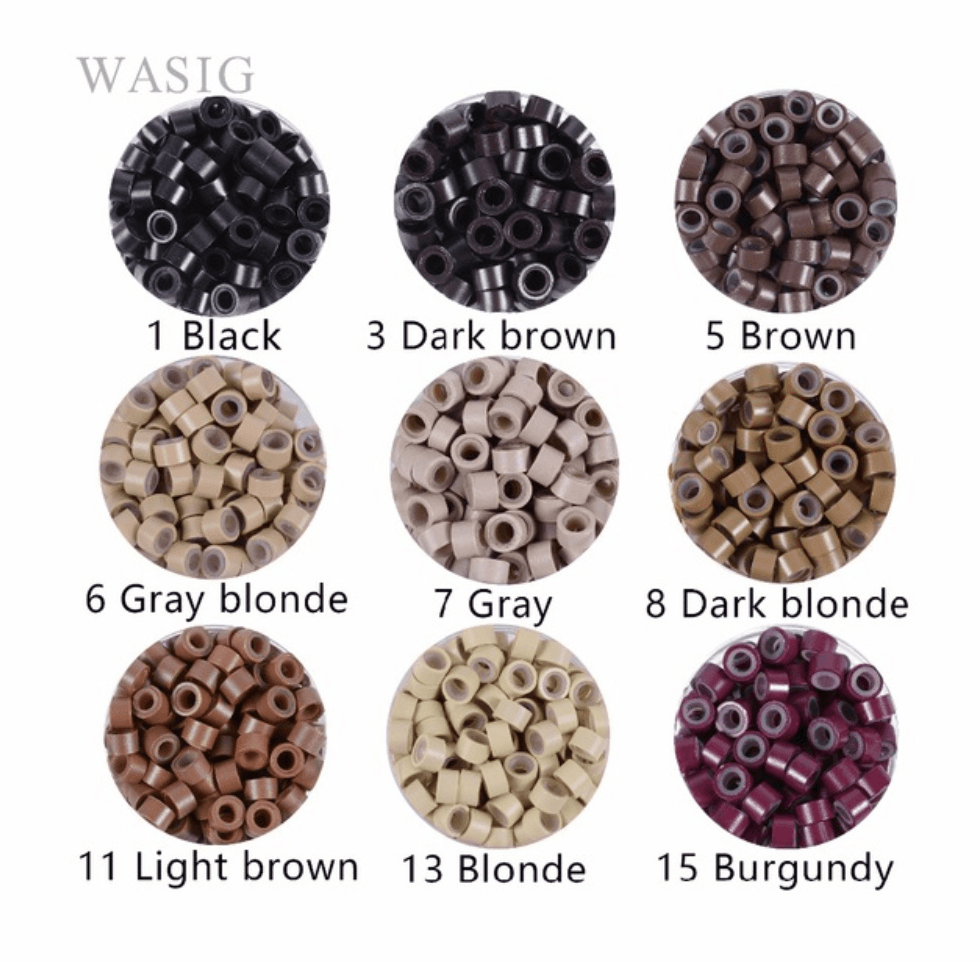
Well-applied cold extensions
For a successful ring extension application, certain criteria must, of course, be met. As you have seen previously, there are several ring colors. The client's hair root color will determine the color of the rings to be chosen. Example: A blonde with dark roots. We will choose blonde hair extensions, but we will favor rings the color of the root, so dark. Definitely no beige rings so that they are not too noticeable.
The extension stick must also be well positioned within the ring. Indeed, it must not protrude so as not to touch the scalp.
As with all other types of hair extension application, the rings should not be fixed too high on the hair. A distance of 1 cm between the scalp and the ring extension is essential.
QUANTITY OF EXTENSIONS
First of all, the quantity of strands is the essential factor for determining the price of hair extensions. Indeed, depending on the length of your hair, its mass, and texture, the number of extensions varies. This means that everyone's needs are different. This is why a personalized quote is always offered free of charge before any appointment. Latou Hair Concept works with photos of hair sent by its clients, taken in daylight without filters, from the back and both sides.
Consider, for example, a person with fine hair. This person will naturally need fewer hair extensions than someone with very thick hair. Similarly, a person who has just cut their hair increases the quantity of extensions needed. Indeed, the goal is to cover the client's natural hair with extensions. However, if the hair has just been cut, it will be more difficult to cover the demarcation. Consequently, this will require more extensions.
The final result you want to achieve is also important. Indeed, if you only want to add a little volume to your hair, the extension application will require fewer strands, and the price will be lower than if you want to achieve a significant increase in length. Consequently, the price of hair extensions is directly linked to the quantity of strands needed.
How many strands do I need?
This summary table will help you calculate the number of extensions needed for your hair. Easily calculate your ideal service using this tool.
| YOUR HAIR LENGTH REACHES THE NAPE | 110 to 125 strands | 125 to 150 strands | 150 to 200 strands |
|---|---|---|---|
| YOUR HAIR LENGTH REACHES THE SHOULDERS | 70 to 100 strands | 100 to 125 strands | 125 to 150 strands |
| YOUR HAIR LENGTH REACHES MID-BACK | 60 to 80 strands | 70 to 100 strands |
100 to 125 strands |
If you want more information on this technique and on hair extension services, you can naturally visit us at our salon in 24700 Montpon-Ménesterol.
THE ADHESIVE EXTENSION APPLICATION TECHNIQUE

Adhesive extension application is the fastest application method. It also has the advantage of allowing your extensions to be reused for a later application. In the blink of an eye, your dream of having fuller, longer hair, or simply a different hairstyle, becomes a reality.
These 100% natural, high-quality extensions confirm the reputation of the Latou Hair Con brand. They allow you to get longer hair and stunning volume in the blink of an eye.
Unlike keratin extensions, adhesive extensions are only applied for a maximum period of 8 weeks. Nevertheless, adhesive strips have the significant advantage of being reusable (up to 8 months). Every 8 weeks, the adhesive (serving as the base for attachment) of the extensions is then changed by your specialist extension hairdresser, and you can again enjoy your extensions for a period of 8 weeks. The total lifespan of the hair is 8 months. This limits long-term expenses since only the repositioning of the adhesive strips is charged by your hairdresser during this period (since the same extensions are kept).
This adhesive extension solution is very easy and offers excellent adhesion without the use of an application machine. The removal of adhesive extensions is also very simple and just as quick.
Adhesive extensions: for what type of hair?
It should be noted that Latou Hair Concept adhesive hair extensions can be used on both fine hair and more voluminous hair. Consequently, Latou Hair Concept extensions adapt perfectly to all hair types. A wide range of colors is available, so all possibilities are possible.
Adhesive extensions: for what type of result?
Generally, adhesive extensions are used for a localized increase in length or volume. For example: you want to transform a bob into an inverted bob. This type of extension is therefore perfectly suitable.
On the other hand, this type of extension may not be suitable if your goal is to apply extensions all over your head. Adhesive extensions are wider than strand-by-strand extensions. Consequently, adhesive extensions are less comfortable than strand-by-strand extensions. That's why it is better to use these extensions localized to a specific part of your hair.
Another use is to add general volume to the hair. In this case, the application does not require many extensions (usually 2 packs). It is therefore possible to use adhesive strips while maintaining a comfortable application.
Finally, a minority of women turn to adhesive tape extensions because they can no longer tolerate traditional "strand-by-strand" extensions. In this case, adhesive extensions are the solution to keep extensions while changing the application method.
If you would like more information on the adhesive extension technique and hair extension services, please visit our salon in Montpon-Ménestérol.
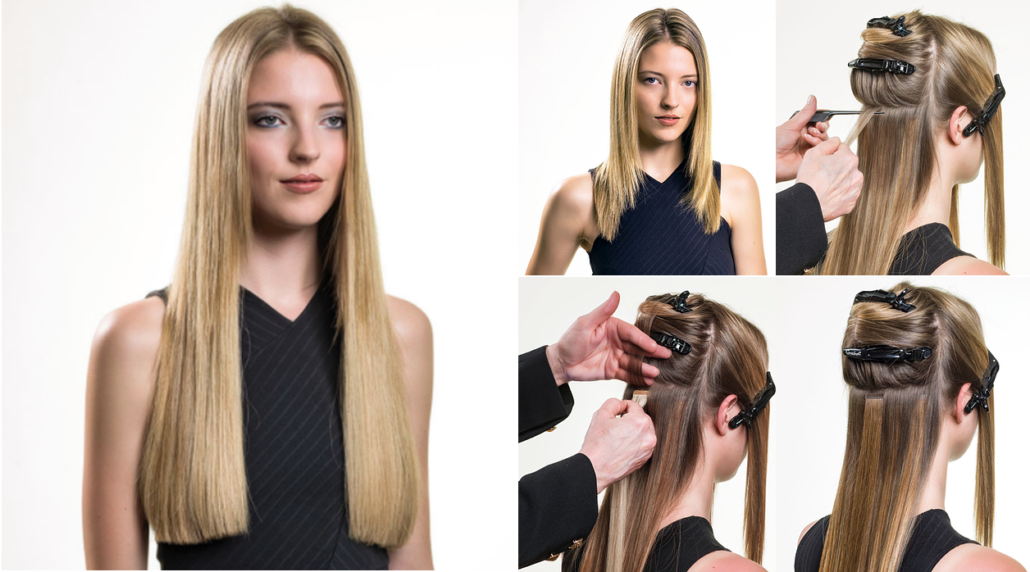
WHY SHOULD YOU ABSOLUTELY CALL A PROFESSIONAL?
Even if applying hair extensions may seem achievable by an untrained person, it is essential not to do it alone or with friends, as a poorly performed application can lead to hair breakage at the bulbs, where the entire weight of the extension strand is exerted.
If the extensions are applied under good conditions, they pose no risk, and when an extension detaches, it simply slides along your natural strand.
For more information, you are welcome to visit our salon at 24700 Montpon - Ménestérol, where you can meet a member of the Latou Hair Co team who will be happy to show you the hair extensions and discuss the most suitable application for your hair.
Clip-in hair extensions
Do you want to achieve mermaid hair instantly, skipping the two-hour application process with a hairdresser? Do you prefer a simplified, practical, accessible, and less expensive solution? Then, clip-in extensions are for you! Their application is even faster and easier than adhesive strips.
Clip-in hair extensions come in the form of fabric strips, equipped with one to five clips, to which rows of natural hair are attached. This type of extension gives you perfect autonomy: no help from a specialized hairdresser is necessary, not even for the first application. You simply place them yourself in your hair in the morning and remove them at night. Thus, you will have no application or removal fees to pay at a hair salon.
However, while permanent extensions (keratin, micro-rings, loops, and adhesive strips) are worn continuously from application until removal*, it is not recommended to keep clip-in extensions on while sleeping or swimming. Furthermore, it is strictly forbidden to detangle or wash your hair without removing them.
On the one hand, this is a definite advantage, as washing and brushing are made easier: no need to worry about the attachment points! On the other hand, you simply need to be comfortable with the contrast between the time you wear them and the time you have to remove them.
Can hair extensions be worn in case of alopecia?
Have you noticed that you are losing your hair? Are you sad to see your scalp exposed in places? I perfectly understand your distress. Fortunately, there are solutions for you too!
If your alopecia is not too advanced, you can opt for the micro-rings mentioned above. They will allow you to regain volume and even length. The gentleness of this application method is ideal for preserving the most fragile hair.
Adhesive tape extensions can also be suitable for you. With their remarkable fineness, they are perfectly concealable and thus allow you to regain volume discreetly!
Alopecia and hair extensions: in what cases are they compatible?
In the case of androgenic alopecia, wearing hair extensions is not just a whim. In this instance, it is not at all a question of impatience regarding hair growth speed, nor a desire for extra length or volume out of pure vanity. It is primarily about compensating for a lack of hair mass.
However, it should be noted that hair extensions and alopecia are compatible under two conditions: if you are a woman and if your condition is not too advanced. An article will soon be dedicated to male alopecia, which has its own specificities and palliative solutions.
For women, find out here which stage applies to you.
If you are at stage 3, it would be preferable to consider a more radical solution such as a wig, a hair prosthesis, a volumizer, or a transplant.
If you are at stage 1 or 2, then you can certainly wear hair extensions! You may also need to adopt specific hairstyles to balance the volume around the head and/or conceal empty areas. But we will come to that later! Good news, in terms of special hairstyles for alopecia, the possibilities are numerous.
Which extensions for fine and thinning hair?
Wearing hair extensions when suffering from alopecia will require targeting suitable products. In other words, it will be necessary to choose the gentlest type of extensions for the hair. Alopecia makes them finer and more fragile, so it is necessary to preserve them as much as possible. Fortunately, there are two varieties of hair extensions that can perfectly suit you. Here they are!
Micro-ring extensions: well-concealed alopecia
Also known as micro-cylinder or cold fusion extensions, they are added to biological hair by a purely mechanical process. A series of strands are attached to your hair using flexible metal rings covered with silicone. This material, perfectly respectful of hair, is not likely to damage it.
Swimming with keratin hair extensions
Keratin extensions and swimming pools, or the sea, are a more delicate matter. Indeed, it is important to know that keratin attachment points soften slightly during swimming... This is why, in this case, the risks of tangling are very real, especially at the roots.
Nevertheless, this is true only if the hair moves when the keratin is thus "melted". If it remains neatly in the same places, then no problem, it will harden again with drying, and nothing will have changed. A braid, two pigtails or a bun are therefore indeed recommended for swimming with keratin extensions. These rigid hairstyles will allow your keratin points to remain securely in place.
By tying your hair like this before going to the beach, pool or lake, you will have no problem swimming. A simple ponytail may theoretically suffice, but only if it is perfectly tight, with a spring-type elastic for example. And for more coquetry, you can opt for a side ponytail or braid.
This is why you can read everywhere that it is imperative to tie your hair in an elaborate hairstyle to go swimming with extensions. But this only concerns keratin extensions! This was the point that needed clarifying.
A second precaution to take: do not wet your hair at the roots within 48 hours of applying this type of extension. First, allow the keratin time to set properly. You can, however, wet the lengths. So, no problem if you dip your feet in the sea and get one or two accidental splashes!
Swimming with adhesive tape extensions
There are no contraindications regarding adhesive extensions and swimming. These are waterproof and permanent, so you can swim while wearing them. They also do not require braiding the hair before going into the water, as is the case for keratin extensions. Because even if the glue is likely to soften slightly, as with the latter, the bands are carefully glued to each other, thus preventing the adhesive material from moving and mixing anywhere.
If you are still worried about your extensions coming off in the water, you can always tie your hair in a braid, bun, or even a simple ponytail. In which case, there's no need to tie it too tight!
The only minor detail to consider is that, as with keratin extensions, you have to wait 48 hours after application before allowing your roots to come into contact with water. This is the time needed for the special glue to properly set on your hair. However, you can wet the lengths.
What to do after swimming with hair extensions?
Instead of towel-drying your hair, it is preferable to rinse off sea or pool water with a good shower and shampoo. This will be more effective! Are you wondering which shampoo to choose? I invite you to read my article on washing extensions.
This article will also enlighten you on why the following recommendation is important...
Once rinsed, carefully detangle your hair with a wide-tooth comb, an accessory gentle enough to undo knots smoothly. Avoid brushes, however, and especially fine-tooth combs. When hair is wet, its cuticles are open, making it more vulnerable. Therefore, it should be handled with softer accessories. And to part your hair, use the tail of a comb designed for this purpose.
Then, I recommend applying oil or another type of hair care product again. This is important to protect against the potential damage of salt, chlorine, or any pollution in lake waters. Personally, I use the same vegetable oil I used as protection before jumping into the water, with the difference that this time, I combine it with olive and coconut oil spray for complete care.
Regarding drying? To best preserve your beautiful extensions, I would recommend air-drying your hair. You can first blot them with a towel to speed up the process a little. If you are really short on time, you can use a hairdryer once in a while... but in that case, set it to a low temperature, or even a cold setting if it has one.
How to swim with clip-in hair extensions
Swimming with clip-in extensions is generally not recommended. While I don't believe the legend that clips can rust underwater (unless they stay there for more than 24 hours!), another problem could arise. The metal clips could damage biological hair, already made vulnerable by swimming. Let's not forget that water opens the hair cuticles, exposing them more to external aggressions. Moreover, the weight of long strands probably doesn't help...
However, it is possible to take a quick dip while wearing your clips, provided you avoid getting your hair wet. You can carefully tie them up in a bun for this purpose.
In summary, here's how to swim with extensions!
- Wet hair with fresh water to prevent salt or chlorine from settling;
- Apply a protective treatment such as a vegetable oil;
- If wearing keratin extensions, tie hair securely (preferably in a braid or bun);
- Reapply a treatment after swimming;
- Allow to air dry.
Lwashing your hair extensions: pre-detangling
If you're already used to wearing long hair, you've probably developed the good habit of detangling it before showering. Perfect! Grab your brush or other suitable accessory to remove knots before rinsing it with water. As you probably know, detangled hair will be easier to manage during shampooing.
But above all, when hair is wet, its keratin scales lift, giving it an appearance similar to that of a pine cone. This effect is visible under a microscope. However, these scales constitute a protective barrier that usually protects them from external aggressions when they are dry.
In other words, wet hair is more porous, it is in a state of fragility. Thus, if you detangle it at that moment, the risks of breakage are increased. This is therefore an essential reason to avoid combing under the shower. It is preferable to take care of it before washing your hair extensions.
What shampoo to use when wearing extensions?
It is important to remember that hair extensions are cut hair; they are therefore no longer nourished at the roots. Hair implanted in the scalp receives a regular supply of sebum, which nourishes it. With brushing, we spread sebum on our lengths, which provides protection, nutrient supply, and shine. Hair extensions, however, are deprived of this natural care.
Furthermore, before being put on sale, hair extensions have been treated with synthetic products: permanent dyes, possible curling products... A second factor that makes them more delicate than hair rooted in the scalp.
Based on this information, have you guessed which shampoo to use to wash your hair extensions? That's right, a mild shampoo, without silicone, sulfate, or parabens is preferred!

How to wash your hair extensions: adopting the right gestures
You wear hair extensions attached to your hair with rings, keratin, or adhesive tapes. So, you are certainly wondering how to wash your extensions thus attached, and especially at the attachment points... It's very simple, the goal here will be to avoid damaging them or causing knots. To do this, simply temporarily abandon certain gestures you were used to before the application.
The following tips apply mainly to keratin extensions, whose glue can soften under the effect of water. Adhesive tape, loop, or micro-ring extensions, however, allow for more flexible handling. The rings are not attached with glue, and as for the tapes, although this is the case, their shape allows for better hair retention. If you wear rings or adhesive tapes, still follow the recommendations below, but the degree of precaution to take may be somewhat reduced.
After wetting your hair, apply a dollop of shampoo to the top of your head. You can easily massage this part of your hair, which has no attachment points. However, for the circumference of the head, which is generously supplied with them, simply spread your shampoo along the lengths by sliding your hands along your hair. Make movements from top to bottom to spread it and not the other way around. And to impregnate your hair with shampoo at the attachment points, do it delicately with your fingertips so as not to damage your attachments.
In summary, to properly wash your hair extensions, the key is to preferably leave your hair in its natural position to avoid tangles, especially if your extensions are keratin-bonded.
How to style extensions after washing?
Before letting your hair dry, you often want to style it to perfect the detangling or to shape it. There is a two-in-one accessory that will become your best friend for this operation, I'm talking about… the wide-tooth comb!
The spacing of its teeth allows you to untangle hair with the greatest delicacy, loosening knots one by one. As a reminder, hair is porous and therefore vulnerable when wet. This is the ultimate solution for combing your hair without damaging anything. Naturally, as with daily styling, you should not venture near the roots, as this could break the attachment points of the extensions.
Another important point, if you want to facilitate detangling, now is the time to use a detangling cream. For natural beauty addicts like me, vegetable oil will be preferred. For keratin or tape-in extensions, however, be sure to apply oil only to the lengths, avoiding the roots. The same goes for treatments, conditioners, or various masks. Their richness in fatty substances could cause undesirable detachments.
The hairbrush, meanwhile, will remain safely in the back of the closet until drying is complete. Even more so, the fine-tooth comb will not come out either until the hair is dry. There's nothing better for "raking" wet hair everywhere, thereby exacerbating the risk of breakage. If you do want to part your hair, prefer the tip of a tail comb.
How to dry extensions?
Your extensions are more delicate than your biological hair. Therefore, after shampooing and styling, I strongly recommend avoiding the hairdryer, which could dry them out.
After washing your hair extensions, it is better to opt for air-drying to preserve them as best as possible. However, it is true that the hair mass is considerably increased when wearing extensions. Thus, the drying time can be long, even very long…
To overcome the problem, you can speed up the process by wrapping your hair in a towel when you get out of the shower. If you keep it on your head for about ten minutes, you absorb a maximum of moisture. For optimal effectiveness, I advise you to invest in a special microfiber hair towel. Ultra-absorbent, these also have a shape more suitable for hair than a bath towel, and are equipped with a button to close them. A tremendous gain in practicality!
If you really don't have time, you can use your hairdryer from time to time, but prefer a low-temperature setting. Today there are models offering a cold drying mode. At worst, you can choose a lukewarm temperature (setting 1), and for the nozzle, prefer the diffuser rather than the flat nozzle.
Apply a treatment after washing your extensions
After washing, why not give your hair a treatment? For my part, I do it right after removing the microfiber towel. Wet hair absorbs what you apply to it better. The cuticles are open, now is the time to saturate them!
Your treatment should also be gentle to preserve both your hair and your extensions. You can use your usual mask if it works well for you. There is no need to invest in a Specific hair extension oil. It has been proven many times that vegetable oils such as olive and coconut oil spray, avocado, hazelnut, sweet almond, or even classic olive oil work wonders.
As a natural enthusiast, which my hair also prefers, I usually spread a dollop of aloe vera and a dab of vegetable oil mixed together. It's a recipe with proven effectiveness over several years in terms of hair health, and what's more, it's also the ultimate mix for defining my curls!
After that, I let it air dry by itself: the result is much better for curly heads. By the way, if you wear wavy or curly extensions, you will also notice that permanent extension strands blend perfectly with your biological hair when air drying. The curls relax under the effect of water and reform as it evaporates. Thus, at that moment, the extension strands will curl in unison with your own strands; the match will be perfect!
How to wash clip-in extensions?
If you have clip-in extensions, you might be wondering if there are any differences in the procedure. In any case, know that you are lucky; it will be easier for you to handle them during washing.
Indeed, it is imperative to wash clip-in extensions separately from your own hair. Since hair is more fragile when wet, leaving clips or other accessories in your hair at that time is likely to damage it. This is even more true with the weight of the extension strands.
It will therefore be necessary to wash clip-in extensions in the sink or in the bathtub when you feel the need. Following similar advice to that recommended for loop or keratin extensions:
- First detangle your extensions with the accessory of your choice;
- Wash them with a shampoo free of silicone, parabens, and sulfates;
- Rinse them thoroughly;
- Comb them with a wide-tooth comb;
- Let them air dry (on a hanger with clips, for example).
The fact that clip-in extensions are removable is a definite advantage. It's nice to be able to massage your scalp and rub your entire hair during shampoos. The same goes for brushing at the roots... and for all other actions that are forbidden when wearing permanent extensions!
How to curl your extensions after washing?
If you're addicted to curling irons, I might surprise you, but... prefer to use it on dry hair. Why? For the reasons mentioned above. I'll repeat myself again, but wet hair is vulnerable because water opens its cuticles, allowing various aggressions to enter. Even major websites like L'Oréal are increasingly recommending drying your hair before curling it. It's better to expose hair with closed cuticles to heat.
Nevertheless, although the effects are reduced on dry hair, direct contact with heat is only recommended for the most resistant hair. So, if yours is among the most delicate, go back to basics with a curling method that Marylin Monroe loved... hair curlers! Indeed, purely mechanical processes are by far the most respectful of our hair.
So, to curl your hair with a natural and 100% healthy method, take advantage of the moments after washing to set your curlers: work on wet hair! Since they are saturated with water, it's the ideal time to give them shape.
And to curl clip-in extensions, nothing could be simpler: you can wrap them around rods and let them dry that way. Personally, I use a wall bar like a towel rack. The result is impeccable! Of course, I have already curled extensions, but sometimes I want to give them some bounce back. Admire the effectiveness of this method: